Watch the Film— "Costa Rica: Pura Vida, Pura Tierra"
Written by Bacha Coffee | 4 mins | Bacha Coffee
Follow the journey of coffee from volcanic soil to the cupping table, and discover a culture in which the pursuit of quality has been refined across generations.
For the second chapter of our
Journeys to the Source film series, we travel into the volcanic highlands of this small Central American country, following Rüdiger Freytag, Bacha Coffee’s Head of Coffee Procurement and Production, as he searches for some of the exceptional 100% Arabica harvests that will join the Bacha Coffee collection.
The land of volcanos
Costa Rica occupies a slender bridge of land between the Pacific Ocean and the Caribbean Sea, crossed through its centre by mountains and volcanoes. For coffee, this geography is a remarkable gift.
Arabica coffee took root in Costa Rica more than two centuries ago, and the country became the first in Central America to establish coffee as a commercial industry. The crop went on to play an extraordinary role in Costa Rican life, helping finance roads, railways and cultural institutions while transforming the highlands surrounding San José into one of the historic coffee landscapes of the Americas.
From the beginning, quality mattered.
Costa Rica developed stringent standards around coffee cultivation and, in 1989, prohibited the commercial cultivation of Robusta as part of an effort to safeguard the reputation of its Arabica harvests.
Across the coffee-growing highlands, mineral-rich volcanic soils meet tropical rainfall, pronounced seasons and cooler temperatures at elevation. Much of Costa Rica’s coffee is cultivated between 800 and 1,600 metres above sea level, where cherries are given time to mature gradually. That slow development matters.
Inside each ripening cherry, sugars develop and the bean becomes denser. Acidity, sweetness, aroma and complexity begin taking shape. The pursuit of flavour has already begun.
There is a phrase for the philosophy encountered along the way: pura vida, the pure life.
On the slopes of Poás Volcano
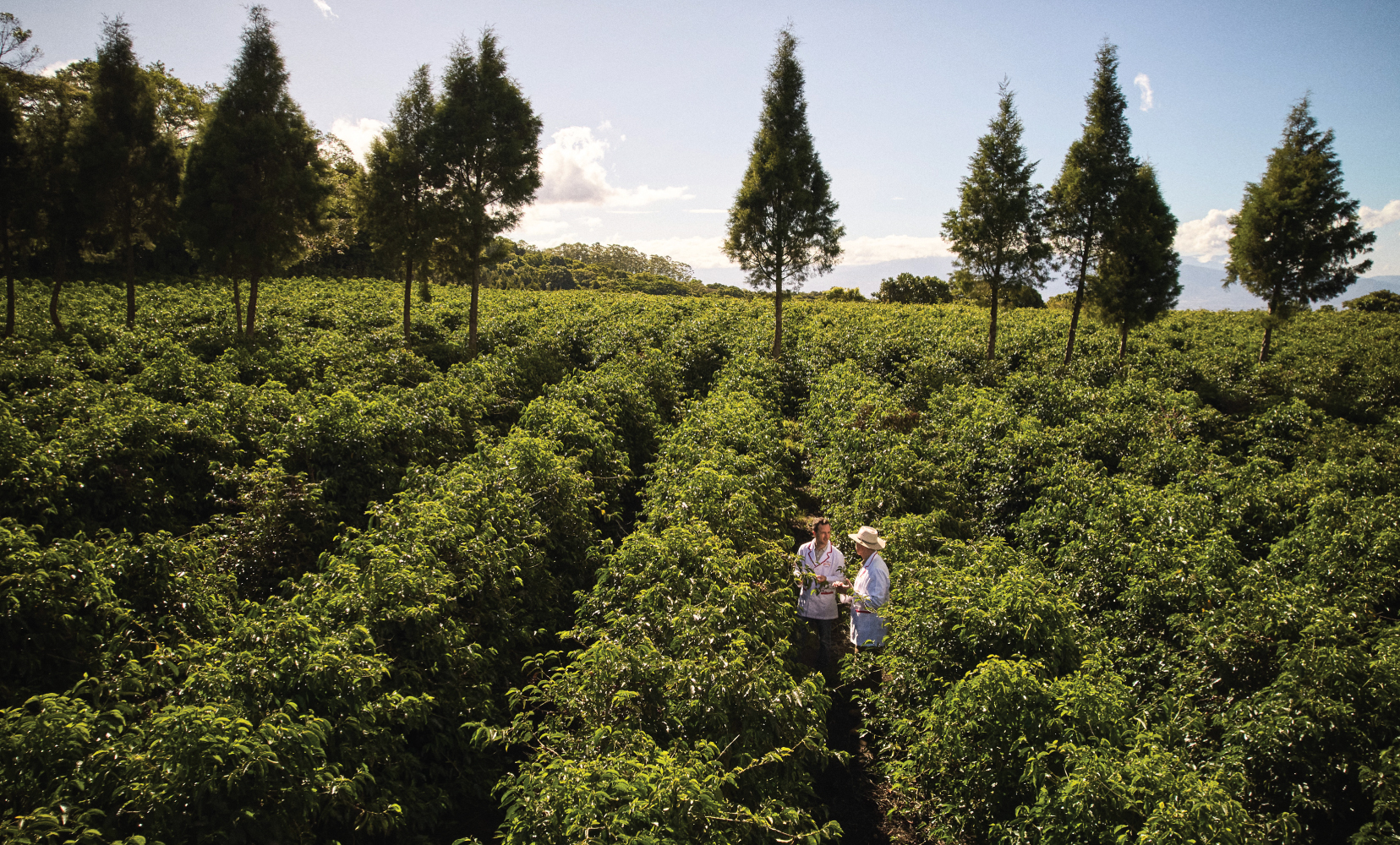
The film travels upwards into the highlands surrounding Poás Volcano, one of Costa Rica’s great stratovolcanoes. Here, on fertile volcanic slopes surrounded by forest, lies Volcán Azul.
Coffee has been grown by the same family for seven generations, a lineage stretching back almost two centuries. A family member who manages the farm today inherited an extraordinary body of knowledge, along with the responsibility of deciding what should be carried forward and what should change. For his family, coffee is both inheritance and future. Over decades, they have preserved extensive areas of forest surrounding their agricultural land. At Volcán Azul, roughly 220 of its 300 hectares are dedicated to conservation.
Walk through the plantation and the distinction between forest and farm begins to soften. Coffee grows among grasses, trees and other vegetation. Birds move through the canopy. Insects and microorganisms occupy the soil. Shade trees are being returned to plantations, ground cover protected and agricultural practices continually refined.
This harmonious relationship between environment and agriculture has consequences for the coffee. The surrounding forest helps lower temperatures and retain humidity across the farm. Under cooler conditions, coffee cherries mature more slowly, allowing denser beans and greater complexity to develop.
One of the farmers describes this relationship through the language of terroir, the elusive combination of place and human knowledge that gives an agricultural product its distinctive character. “Having a healthy ecosystem is not only helping the environment,” he explains in the film. “It’s also helping the quality of our coffees.”
The forest, in other words, eventually finds its way into the cup.
A journey to the source
For Rüdiger, travelling to Costa Rica means understanding these relationships first-hand. And the sourcing journey begins in the landscape.
He walks the plantations with the farmers, examines the harvest, studies how the coffee is being cultivated and asks how conditions have changed from previous years. Conversations continue at the mill and eventually around the cupping table.
“There are several motives to come to the source of coffee,” he explains. “It’s a relationship with the farmer. It is for them to understand what we’re looking for, and for us to understand how the coffee is grown, how things really develop.”
Coffee is agricultural, and agriculture is never static. Rainfall changes. Temperatures shift. Harvests vary. A variety flourishing on one mountainside may behave very differently elsewhere. Returning to the source allows knowledge to accumulate. It also allows relationships to deepen.
For the farmer Bacha Coffee works with, understanding the particular profiles sought by Bacha Coffee can guide experiments with varieties, cultivation and processing. For Rüdiger, tasting alongside the people who grew the coffee provides an opportunity to trace flavour back through the many decisions that created it.
This exchange is part of the savoir-faire behind every exceptional harvest.
.jpg "Bacha-Coffee---Journeys-to-the-Source---Costa-Rica---Harvesting-coffee-cherries-in-plantation,-grecia-region-(48)")
Expressions of flavour
Gesha is among the most celebrated varieties in contemporary fine coffee. At altitude, its yields are modest and its cultivation demanding, yet under the right conditions it can develop extraordinary aromatic refinement.
At Volcán Azul, the variety reveals delicate floral and citrus characteristics, an elegant structure and a lingering complexity. Processing brings another dimension.
For Volcán Azul Red Honey, part of the coffee cherry’s naturally sweet mucilage remains around the bean as it dries. Managing this process requires precision. Time, temperature and moisture must be carefully controlled as the coffee develops its fruit character, sweetness and texture.
Naranjo Mountain and Volcán Azul offer another interpretation. These fully washed coffees undergo a process in which the fruit surrounding the bean is removed before drying, allowing the intrinsic qualities of the coffee to emerge with particular clarity. Fresh citrus. Malt. Fruit. Chocolate. Different processes reveal different facets of the same landscape.
.jpg "Bacha-Coffee---Journeys-to-the-Source---Costa-Rica---Bacha-Coffee-Cupping,-Bacha-Heritage-chantilly-cup-and-saucer-(143)")
From cherry to cup
The film follows these transformations closely. Ripe cherries are selected from the trees and gathered by hand. They are weighed and carried down from the plantation. At the mill, fruit is removed, beans are washed or prepared for honey processing, then carefully dried. There is considerable precision hidden inside these seemingly simple actions. The ripeness of a cherry at the moment it is picked affects sweetness. Processing influences acidity, texture and fruit character. Drying too quickly or too slowly can alter the final result. Weeks later, all of those choices meet again around a table.
Cupping is where the landscape becomes legible. Rüdiger and the farmers lean over a row of cups, spoons in hand, tasting coffees from the harvest. There is slurping. Silence. Consideration. Another spoonful.
“When you taste the coffees, you’re looking for complexity in a cup,” Rüdiger explains. “You’re looking for all these special flavours you won’t get in a mass-produced coffee.”
For an experienced coffee professional, flavour can be read backwards. A floral note may lead towards variety and altitude. Sweetness may speak of ripeness or processing. Clarity can reveal the precision of a washed coffee. Texture can carry traces of fruit left around a bean during honey processing.
A cup becomes a record of everything that happened before it.
The art of roasting
Producing an exceptional “green coffee” (before roasting) is only half of the work. That second half carries considerable responsibility. Years of cultivation can be diminished in minutes by careless roasting. The character developed in the landscape must therefore be understood, preserved and finally revealed.
When Rüdiger eventually leaves Costa Rica, selected coffees continue onwards to Marrakech. There, Bacha Coffee’s roasting savoir-faire begins another transformation, carefully revealing the aromas and characteristics created thousands of kilometres away on Costa Rica’s volcanic slopes.
Only then is the journey from soil to cup almost complete.
.jpg "Bacha-Coffee---Journeys-to-the-Source---Costa-Rica---Rudiger-Freytag-resting-on-wall-with-bacha-heritage-coffee-cup-and-saucer(21)")
Pura vida, pura tierra
Pura vida is heard everywhere in Costa Rica. Literally, it means “pure life”, although translation captures only part of its meaning. It’s a greeting, a farewell, an expression of gratitude and an attitude towards living that has become inseparable from Costa Rican identity.
Among the coffee farms of the highlands, the phrase acquires another resonance.
There is purity in the landscape. Patience in the cultivation. Pride in knowledge handed from one generation to another. There is an understanding that the quality of what is harvested depends upon the health of the place from which it came. And eventually there is coffee.
Costa Rica: Pura Vida, Pura Tierra journeys back to that beginning, into forests and volcanic soils, through generations of savoir-faire and the meticulous transformations of harvest and processing.
It’s the story contained within a cup of exceptional Costa Rican coffee. Watch the film and journey to the source.